Aqaba and Iraq: a wartime opportunity does not make a permanent corridor
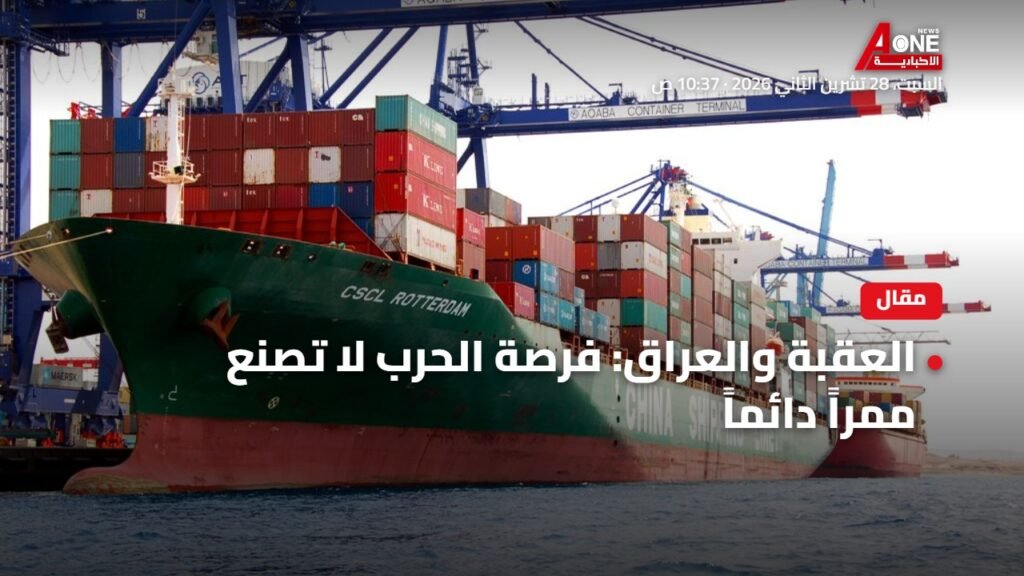
In just nine months, the port of Aqaba has gone from a marginal stop in Iraq's trade to one of its main arteries. Iraq-bound containers through Jordan's only port jumped from fewer than 5,000 TEUs to more than 56,000, and the container terminal posted an unprecedented monthly figure in October, with around 1,500 trucks leaving it every day.
The reason is known to all. The Strait of Hormuz has become an unreliable route, and the US blockade on Iranian ports remains in place. Goods that used to enter Iraq through Basra and Umm Qasr are now unloaded at Aqaba and then trucked some 760 kilometres to the border. These figures deserve to be celebrated, but they also call for a measure of caution.
Trade naturally follows the shortest and cheapest route. Basra and Umm Qasr are inside Iraq and require neither long overland haulage nor border crossings at Karameh and Trebil. The war changed neither the distance nor handling costs; all it changed was the cost of risk on the Gulf route. When that cost returns to normal, traders' calculations will return with it.
Grain is a clear example. Multipurpose bulk cargo has no loyalty to any port and moves every week to wherever costs are lowest; it will be the first to return to Iraqi ports. Baghdad itself is also planning routes that bypass Hormuz without passing through Jordan. It has restarted the Kirkuk–Ceyhan pipeline to Turkey and announced a line from Basra to Haditha. These are primarily oil projects, but they say clearly where Iraqi planning is heading: north and west across its own territory. As for the long-discussed Basra–Aqaba pipeline, it has not moved.
Even so, Aqaba will not return to where it was before the crisis. Companies that brought Aqaba into their supply chains this year have built contracts, warehouses and relationships with transport firms in Jordan, and these are not undone overnight. Insurers will not quickly forget Gulf risks. Jordan is offering discounts on transit fees, has expanded vehicle storage yards from 6,000 to 17,000 spaces, and is talking about accelerating the port's expansion, the Aqaba–Shidiya–Ma'an railway and a dry port in Ma'an.
Most importantly, Iraqi importers learned a lesson this year: a single sea gateway is a point of weakness. Some traders will keep Aqaba as a second route even if it costs them more, just as one keeps a spare house key.
The danger is not that volumes will fall. They will fall when Hormuz returns. The danger is that we build on this year's figures as if they were the new norm: that they enter the 2027 budget, that we borrow against them, or that we pour money into heavy fixed assets designed for volumes that may not last.
The investment that pays off in all scenarios is the lighter and smarter one: faster customs, data unified with the Iraqi side, pre-clearance, and borders that work without queues. These serve Aqaba today and remain useful tomorrow, when competition with Umm Qasr intensifies.
The war has given Aqaba a rare chance to prove itself to Iraqi traders. What remains after the war will not be determined by exceptional figures, but by the speed, cost and reliability of service. That is where the corridor is won or lost.
Sources: Al Ghad (1 November 2026), Petra (2 November 2026), Splash247, Al Jazeera and the Associated Press (27 November 2026), The National (17 November 2026), Baird Maritime citing Reuters.
Translated from the Arabic original.